Why Did Patema End Up Upside Down?

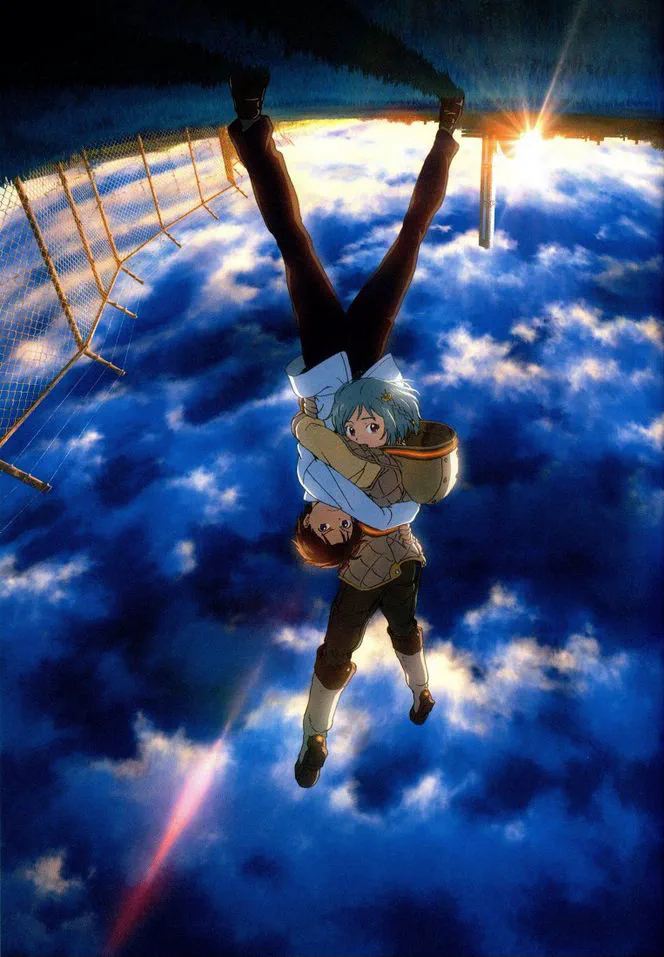
In Patema Inverted, there exist two worlds whose directions of gravity are exact opposites: the world where Patema lives (hereafter, World P) and the world where Age lives (hereafter, World A). Not only the characters but even the matter in the film seem programmed to obey the law of gravity belonging to their own world. And yet the fact that Patema and Age can communicate through language, and that Patema, who belongs to World P, can eat and digest bread from World A, suggests that the two worlds can clearly interact with one another and share something in common at their core.
What’s worth paying close attention to in the film is how differently World P and World A educate their children. The adults of World P do not tell young children that World A exists. For instance, even when Age is helped by Porta into entering the underground world, the village chief and the other adults try to keep the children from seeing him. That’s why, before meeting Age, all Patema knew was fear at the sight of a “bat-man” — she had no idea World A existed. And as the chief says just before Age and Porta set off to rescue Patema, information is given only when it is absolutely necessary. World A, on the other hand, is ruled by Izamura, who indoctrinates students almost like a religion: that World A alone is the absolute truth, and World P is a fallen world. Izamura, as the symbol of the absolute power governing education in World A, therefore carries enormous significance within the film.
What’s ironic about the film is that even a viewer who watches all the way to the end is left unsure which world — A or P — came first, before the gravity experiment of the past took place. That’s because World A has grassy plains you can walk on and a sky with stars, and World P likewise has grassy plains and a sky with a moon. It’s only when Patema and Age fall into the sky of World A that they discover the beautiful stars seen from the ground were, in fact, the lights of countless factories. What lies in the sky of World P, however, is never revealed, so there’s no clue from which to determine which side is the “right-side-up” world and which is “upside down.” But then again, the word “upside down” was never an absolute measure to begin with — it only expresses a relative direction. In the end, the only truth we can objectively arrive at is that World P and World A coexist. And that was precisely the greatest error Izamura made.
In real-world education, though, an Izamura-like approach isn’t hard to find. Take, for example, a student who wants to become a composer. Since an aspiring composer is still at the stage of learning how to write music, they need to experiment — trying different genres, mixing genres, rewriting existing pieces. Yet plenty of people teach beginners that they must first know “what kind of piece they should write.” Something similar happens in the world of research. Undergraduate and graduate students who are still searching for a research topic are sometimes expected to already know, before even enrolling or at the very start of their research, exactly what they will study. But being a student means learning through many attempts and failures — it is not a stage at which one is supposed to have already settled on a research topic from day one. That gap can, at times, turn into a structure that subordinates students to the needs of their advisors.
So why doesn’t this Izamura-style education easily disappear? Probably because it’s a structure in which knowledge itself becomes the basis for status and authority — just as Izamura used knowledge to rule World A. The authority to evaluate is likewise a symbol of the influence an educator wields over a student. As in the film, a grading system can sometimes become a tool that pushes students in a single direction. And this kind of structure becomes most vulnerable at the very moment its existing foundation of knowledge is shaken by someone unconventional — much like when Age tells Izamura, “You’re afraid.” If Age’s father, who once flew through the sky, had shared that hope with the people of World A, they might have come to acknowledge World P as a world in its own right. And if that had happened, Izamura’s belief that World P was a fallen world would have collapsed from its very roots, and the power that sustained him would have vanished along with it.
Age’s father can be compared to Galileo Galilei. Galileo championed heliocentrism — the idea that the earth is not the center of the universe but instead revolves around the sun — and, after colliding with the worldview of his time, was found guilty by the Inquisition, forced to recant his claims, and spent the rest of his life under house arrest. Once the geocentric model was shaken, the authority built on top of it was shaken too. In other words, what an attitude like Izamura’s truly fears may not be the truth itself, but rather the moment the knowledge propping up one’s own status starts to shake.
A similar tension exists in academia. Even when better new technologies and theories emerge, there’s a persistent tendency to cling to the familiar and resist new attempts. In computer technology, for instance, five years can bring as much change as several decades might in other fields. That’s why a technical book can go stale within a year or two of publication, and why a programmer who masters one technology often finds, five years later, that the whole approach has changed and must be relearned from scratch. In an environment like this, there are clear limits to teaching decades-old foundational knowledge as if it were fixed, unchanging truth. Thankfully, some mentors advise: “The future is always changing, so instead of trying to memorize today’s knowledge, use it as a foundation to design tomorrow’s technology.” Still, it will likely take a long time for that perspective to reshape the education system as a whole.
Words like “upside down,” “wrong,” and “incorrect” all stem from an attitude that refuses to acknowledge the other. We don’t call people from other countries aliens, or people whose insides are somehow upside down, or fallen beings — precisely because we recognize them as people just like us. In this sense, the word “upside down” only surfaces when we refuse to acknowledge someone else, when we treat what’s different as what’s wrong. And yet, whether we realize it or not, we use this kind of language all the time — dismissing a new theory as wrong simply because it doesn’t match what we already know, or writing someone off as strange simply because they’re different from us. But if we only see a world different from our own as bad and wrong, we can never understand the truth within it — just as everyone in World A except Age failed to understand the beauty of the stars. In other words, it was Izamura’s attitude that made Patema “upside down.”
So the way we educate needs to change as well. For children growing up, it’s better for education to let them take the lead in solving problems on their own, and to offer knowledge only at the moment it’s truly needed. In Germany, I’m told, formal instruction in reading and writing doesn’t begin until around what would be third grade for us — the idea being that learning letters too early can trap one’s thinking within them. Coming to understand things for yourself, and awakening to the beauty of a field of study on your own terms, is where real joy lies — just as Patema, standing in World A with nothing but sky beneath her feet and the very real possibility of falling, came to understand the beauty of the stars floating there. To a young child looking at the world, nothing is impossible, and no world is the wrong one. The world simply exists as a representation. And yet, much of education is still built around memorization and exam preparation, narrowing the room for creativity to flourish from an early age. Grow too used to that, and when we encounter a new world, we risk labeling it bad or wrong simply because it differs from what we know — coming to resemble Izamura ourselves. What we need, then, is not simply reading more books and piling up more knowledge, but an education that helps people think deeply for themselves, see the world from new angles, and discover the joy of learning. Only then, perhaps, can we truly come to understand the beauty of the stars — and pass that understanding on to others.